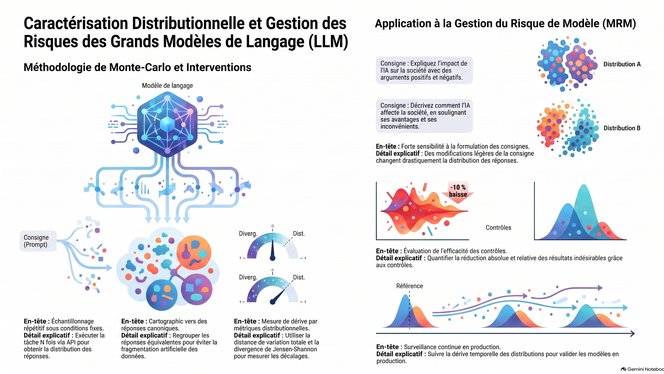
L'intégration des grands modèles de langage (LLM) dans les institutions financières bouleverse la gestion du risque de modèle (MRM) en raison de leur nature stochastique.
Pour dépasser l'incertitude des modèles traditionnels, l'article propose un cadre empirique fondé sur des simulations Monte-Carlo. Cette méthodologie modélise la distribution des réponses, évalue la sensibilité sémantique et la dérive comportementale, tout en mesurant l'efficacité des garde-fous.
Incapable d'être cadrée par les approches déterministes classiques, cette méthode non intrusive permet d'auditer les modèles « boîte noire », d'assurer la conformité réglementaire (EU AI Act) et d'objectiver la gouvernance des IA en production.
The framework presents a method to quantify #uncertainty propagation in #dynamic #scenarios, focusing on discrete #stochastic processes over a limited time span. These dynamic uncertainty sets encompass various uncertainties like distributional ambiguity, utilizing tools like the Wasserstein distance and $f$-divergences. Dynamic robust #risk #measures, defined as maximum #risks within uncertainty sets, exhibit properties like convexity and coherence based on uncertainty set conditions. $f$-divergence-derived sets yield strong time-consistency, while Wasserstein distance leads to a new non-normalized time-consistency. Recursive representations of one-step conditional robust risk measures underlie strong or non-normalized time-consistency.
"This paper examines a #stochastic one-period #insurancemarket with incomplete information. The aggregate amount of #claims follows a compound #poisson distribution. #insurers are assumed to be exponential utility maximizers, with their degree of #riskaversion forming their private information. A premium strategy is defined as a map between risk types and premium rates. The optimal premium strategies are denoted by the pure-strategy #bayesian #nash equilibrium, whose existence and uniqueness are demonstrated under specific conditions for the demand function..."
The paper discusses #modeling #longevity #risk, focusing on assumptions in #demographic #forecasting to project past data into the future. #stochastic forecasts are crucial to quantify #uncertainty in cohort survival predictions, including process variance and parameter/model errors.
"This model allows to be more conservative regarding extreme events while keeping tractability. We give a method based on Conditional Least Squares to estimate the parameters on daily data and estimate our model on eight major European cities... This new model allows to better assess the risk related to temperature volatility."
"... we introduce a novel methodology to model rating transitions with a stochastic process. To introduce stochastic processes, whose values are valid rating matrices, we noticed the geometric properties of stochastic matrices and its link to matrix Lie groups."
"These parameters can be calibrated using public data. This new approach means not only to evaluate climate risks without picking any specific scenario but also allows to fill the gap between current one year approach of regulatory and economic capital models and the necessarily long-term view of climate risks by designing a framework to evaluate the resulting credit loss on each step (typically yearly) of the transition path. This new approach could prove instrumental in the 2022 context of central banks weighing the pros and cons of a climate capital charge."