FSB 2025 Annual Report
Systemic Financial Risks in the Digital Frontier: An Analysis of Modern Operational Vulnerabilities
1. Introduction to the Digital Risk Landscape
The rapid pace of digitalization and technological innovation is fundamentally restructuring the risk profile of the global financial industry. While these advancements drive efficiency, they simultaneously introduce complex operational and digital risks that pose significant threats to global financial stability. According to the FSB report, these systemic vulnerabilities are primarily concentrated within artificial intelligence (AI), third-party dependencies, and the resilience of underlying financial infrastructure. For risk management professionals, identifying the interdependencies between these sectors is critical to understanding how localized technical failures can escalate into global financial instability.
2. Artificial Intelligence: Vulnerabilities and Governance Gaps
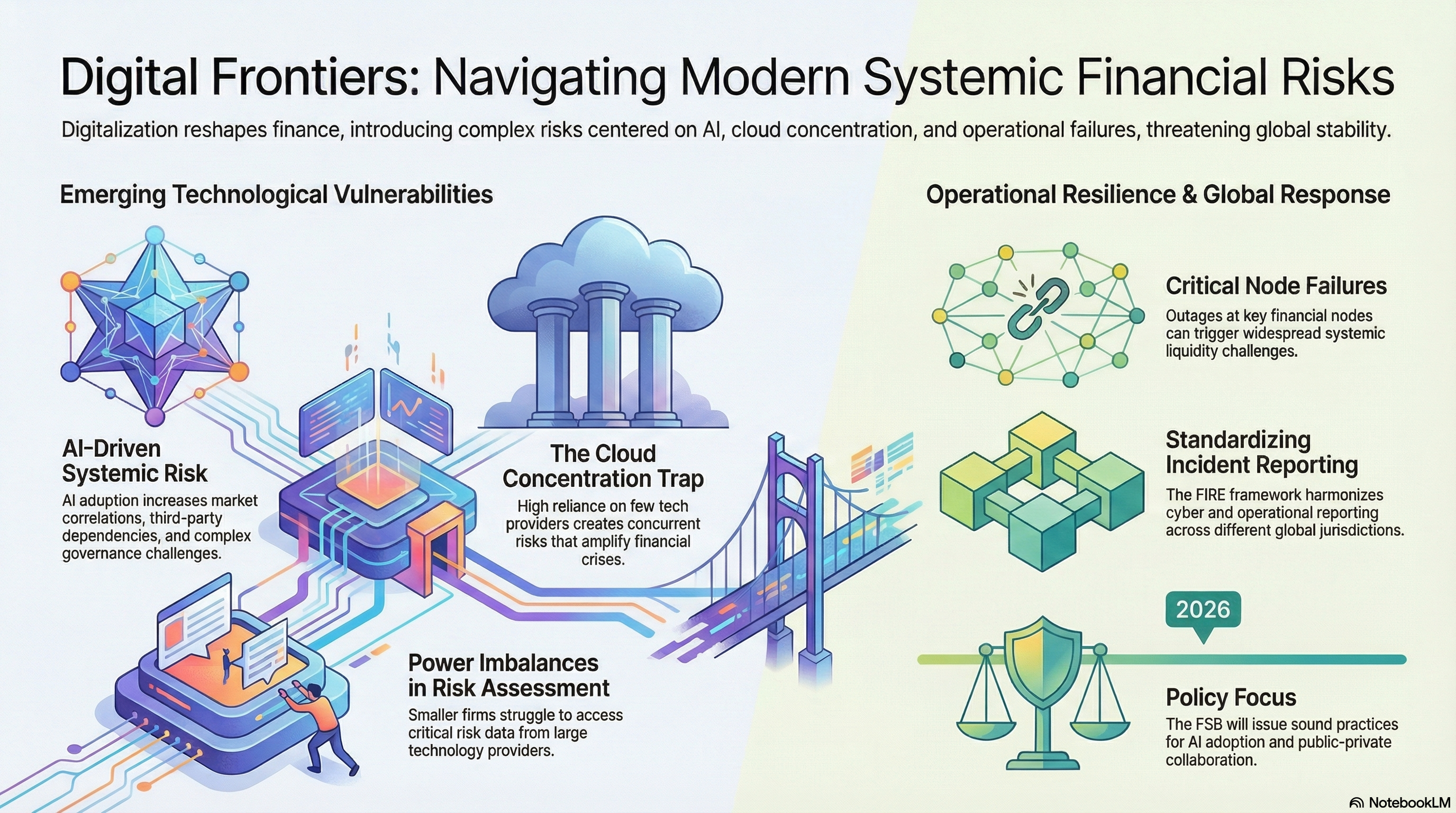
The widespread adoption of artificial intelligence (AI) serves as a primary catalyst for several emerging systemic risks. The report indicates that AI adoption functions as a multiplier, intensifying third-party dependencies, market correlations, and cyber risks. Crucially, the growth of resource-intensive AI models is a major driver of the financial sector's reliance on a limited number of cloud providers, thereby directly contributing to the concentration risk observed in global digital infrastructure.
From a strategic perspective, Governance Challenges remain a significant hurdle, particularly regarding model risk management and governance. The inherent complexity and "black box" nature of advanced AI models often exceed the internal oversight capabilities of financial institutions. Furthermore, the FSB and other authorities have identified specific Monitoring Gaps that hinder a comprehensive understanding of the risk landscape:
- Authorities are currently collecting substantial data regarding the pace of AI adoption across the sector.
- However, most financial authorities remain in the early stages of monitoring the actual systemic vulnerabilities and emergent risks produced by these models.
- The lack of standardized metrics for AI risk makes it difficult to benchmark resilience across different jurisdictions.
To address these deficits, the FSB has established a 2026 timeline for issuing a comprehensive report on sound practices for AI adoption, use, and innovation.
3. Operational Resilience and Systemic Outage Vectors
The report emphasizes that systemic vulnerabilities are increasingly tied to Critical Node Failures. Prolonged outages at global financial institutions or essential market infrastructure providers do not merely represent technical failures; they function as liquidity traps. Because of the high degree of interconnectedness between infrastructure providers, the inability of a single critical node to process transactions can trigger severe liquidity challenges that cascade throughout the global financial system.
These systemic outages are generally categorized by their origin:
- Internal operational incidents resulting from software failures or hardware malfunctions.
- Malicious attacks or cyber incidents intended to disrupt financial continuity.
To mitigate the friction of information exchange during such events, the FSB finalized the Format for Incident Reporting Exchange (FIRE). The strategic objective of FIRE is to harmonize cyber and operational incident reporting across various jurisdictions. By standardizing communication, FIRE aims to reduce the operational overhead of reporting during a cross-border crisis, enabling a more rapid and coordinated global response to critical node failures.
4. Third-Party Dependencies and Cloud Concentration Risks
The increasing reliance on a small cluster of technology service providers-specifically for cloud computing-has created a profound concentration risk. This dependency ensures that a single technical failure or cyber event at a provider can lead to concurrent financial and operational events across hundreds of institutions simultaneously. The sources suggest that the intensification of AI development further deepens this reliance, as the compute power required for modern models is largely centralized within these same dominant providers.
This structural reality creates Power Imbalances between global technology firms and financial entities. Such imbalances present a significant barrier to systemic vulnerabilities management, as smaller firms often face major challenges in accessing information required for robust risk assessments. This lack of transparency prevents smaller institutions from performing adequate oversight, creating significant blind spots for regulators attempting to map systemic dependencies.
To bolster operational resilience, several jurisdictions are currently encouraging specific Mitigation Strategies:
- The development of private cloud services to diversify infrastructure and reduce public cloud exposure.
- The implementation of pooled audits, allowing multiple firms to jointly assess the security of shared third-party providers.
- The maintenance of outsourcing arrangement inventories, which is critical for the recovery phase of operational resilience, particularly when responding to ransomware or large-scale malicious attacks.
The FSB's 2023 toolkit is presented as the primary global reference for managing these third-party relationships through their entire lifecycle, from due diligence to exit strategies.
5. Future Regulatory Focus and Collaborative Initiatives
The FSB's strategic roadmap for 2026 emphasizes public-private sector collaboration as the cornerstone for strengthening the financial sector's ability to prepare for and recover from major operational disruptions. A central component of this focus is a planned "stocktake" of member initiatives concerning regulatory and supervisory modernization. These efforts aim to ensure that national oversight frameworks keep pace with the rapid evolution of the digital frontier. The ultimate goal, as outlined by the sources, is to achieve global alignment in managing systemic vulnerabilities and operational and digital risks, ensuring that technological innovation does not outpace the mechanisms required to maintain international financial stability.