ESAs ask for geopolitical risk Integration and Solvency II review
Geopolitical Risk Integration and the Solvency II Regulatory Evolution
1. Integration of Geopolitical Risk into Governance Frameworks
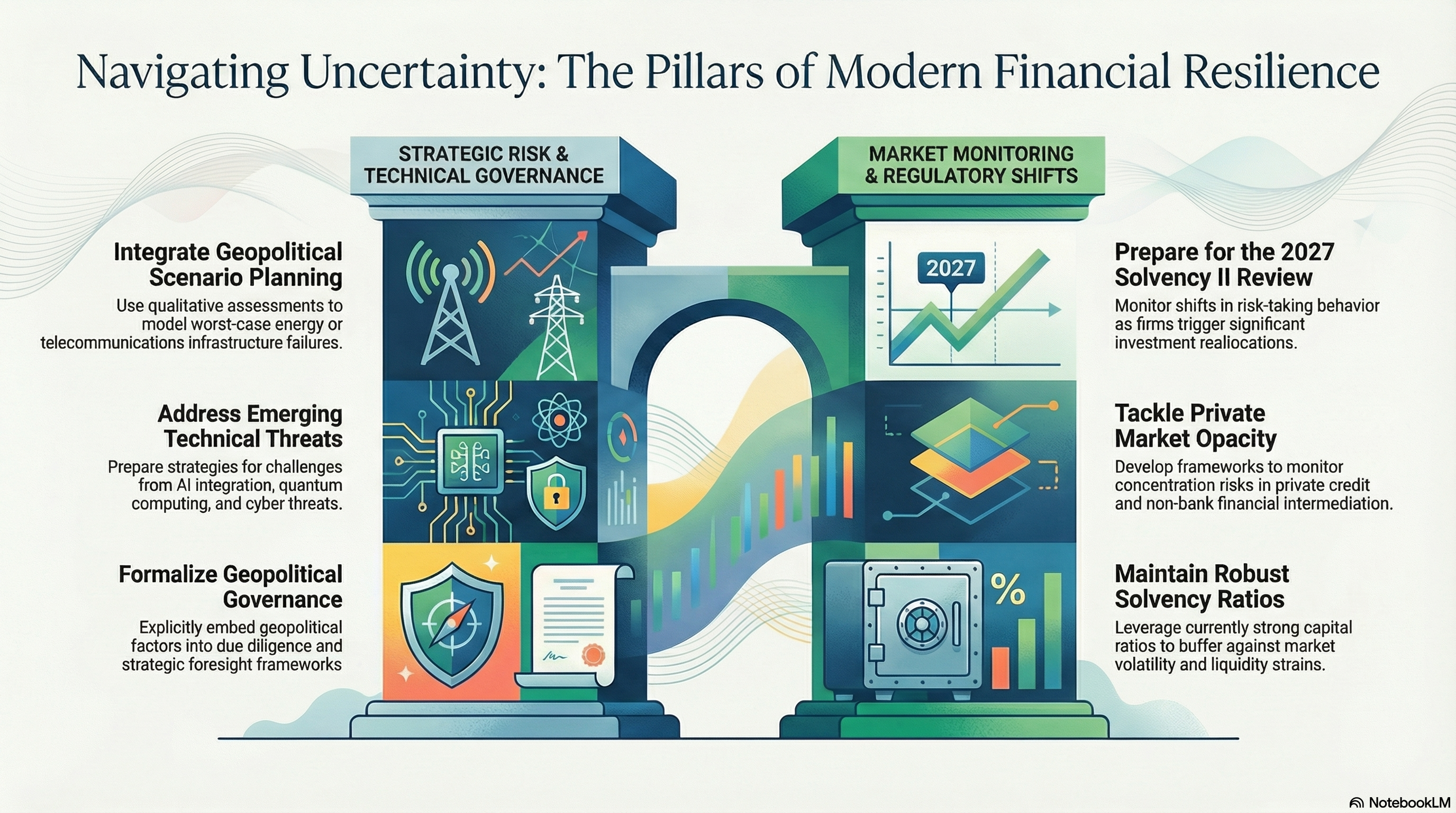
It is a regulatory imperative for financial institutions to move beyond ad-hoc responses and formally integrate geopolitical risk into their internal governance and risk management frameworks. Firms must execute enhanced due diligence and embed geopolitical factors directly into their organizational planning processes to ensure resilience against global instability. This formalization is achieved through three specific qualitative methodologies designed to bolster the due diligence process:
- Qualitative Assessments: Utilized to contextualize non-numeric geopolitical triggers that traditional quantitative models may overlook.
- Expert Judgment: Deployed to bridge data gaps and provide nuanced calibration for tail-risk scenarios where historical data is insufficient.
- Strategic Foresight: Applied as a long-term horizon-scanning tool to anticipate structural shifts, allowing firms to adjust their risk appetite before threats manifest in market pricing.
2. Methodologies for Scenario Planning and Operational Resilience
Institutions must deploy comprehensive scenario analysis to rigorously evaluate the potential degradation of capital, liquidity, and funding positions during periods of extreme geopolitical stress. These risk management strategies are required to account for "worst-case scenarios," ensuring operational continuity even during severe systemic shocks.
Focus Area | Potential Failure Point |
Physical and Energy Assets | Energy supply outages |
Digital and Operational Assets | Telecommunications and communication infrastructure failures |
3. Monitoring Exposure in Private Markets and Sovereign Debt
Private Markets and Non-Bank Financial Intermediation (NBFI) The rapid expansion of private finance, characterized by relative opacity, necessitates the development of robust monitoring frameworks for private credit and NBFI exposures. Heightened due diligence is mandatory to mitigate risks stemming from a lack of transparency and the prevalence of untimely valuations. Furthermore, a critical supervisory priority is the rigorous monitoring of concentration risks, specifically regarding third-country exposure monitoring, to prevent unaddressed systemic vulnerabilities.
Sovereign Exposure Management In an environment of escalating sovereign spending, institutions must maintain the cautious management of sovereign exposures. Given the prevailing debt sustainability concerns, portfolios must be insulated against fiscal volatility and its potential to destabilize broader market liquidity.
4. Emerging Technical Risks in Financial Markets
Risk management strategies must proactively address the systemic vulnerabilities and structural market risks introduced by the rapid evolution of technology. Firms are required to prepare for three primary challenges to market integrity:
- Cyber threats: Systemic disruptions to financial infrastructure.
- Quantum computing: The potential obsolescence of current cryptographic security standards.
- AI model integration: The introduction of algorithmic bias or unforeseen correlations in automated trading and risk assessment.
5. The 2027 Solvency II Review and Sectoral Impact
As the insurance sector approaches the 2027 Solvency II Review, institutions must prepare for significant regulatory shifts that will fundamentally alter the investment landscape.
- Review Implications: The 2027 adjustments are expected to trigger a widespread investment reallocation across the sector. This shift will likely modify the risk-taking behavior and overall risk profiles of both insurance firms and Institutions for Occupational Retirement Provision (IORPs).
- Current Solvency Status: The sector currently maintains a robust solvency position. Median Solvency Capital Requirement (SCR) ratios have shown recent slight increases, reflecting a stable foundation for life, non-life, and composite insurers as they transition toward the new regulatory framework.
6. Conclusion on Proactive Institutional Preparedness
Navigating the current landscape of geopolitical instability and regulatory transition requires an authoritative and proactive stance. Institutions must prioritize comprehensive recovery planning and the implementation of rigorous provisioning to mitigate potential liquidity strains and market volatility. Maintaining a high state of readiness to react to emerging risks is the only viable path to ensuring long-term institutional stability and market integrity.