Insurance Europe position on the European Commission’s Digital Omnibus package
The Regulation Silver Lining: Why European Insurers are Winning the Cyber Resilience Game
For many European insurers, the relentless march of digital regulation-from the foundational GDPR to the recent Digital Operational Resilience Act (DORA)-has long been viewed through the lens of "compliance fatigue." The administrative burden of navigating overlapping frameworks is often seen as a "compliance tax" that siphons resources away from innovation and toward legal preservation. In a global market, this friction has historically been framed as a disadvantage for European firms compared to those in less-regulated jurisdictions.
However, as a Senior InsurTech Analyst observing the implementation of the Digital Omnibus initiative, I see a different narrative emerging. We are witnessing a pivot where these regulations are no longer just red tape; they are being forged into a massive strategic advantage. By systematically removing structural frictions, the European regulatory environment is shifting from a source of fatigue into an engine for "operational alpha."
The transition currently underway is moving the sector away from fragmented, reactive compliance and toward a unified model of strategic resilience. This isn't merely about avoiding fines-it is about building a robust, data-driven insurance ecosystem that turns regulatory coherence into a competitive edge. Here is how the "compliance tax" is being reinvested into industry-wide resilience.
The End of Fragmentation: Leveraging the Single-Entry Point for Operational Alpha
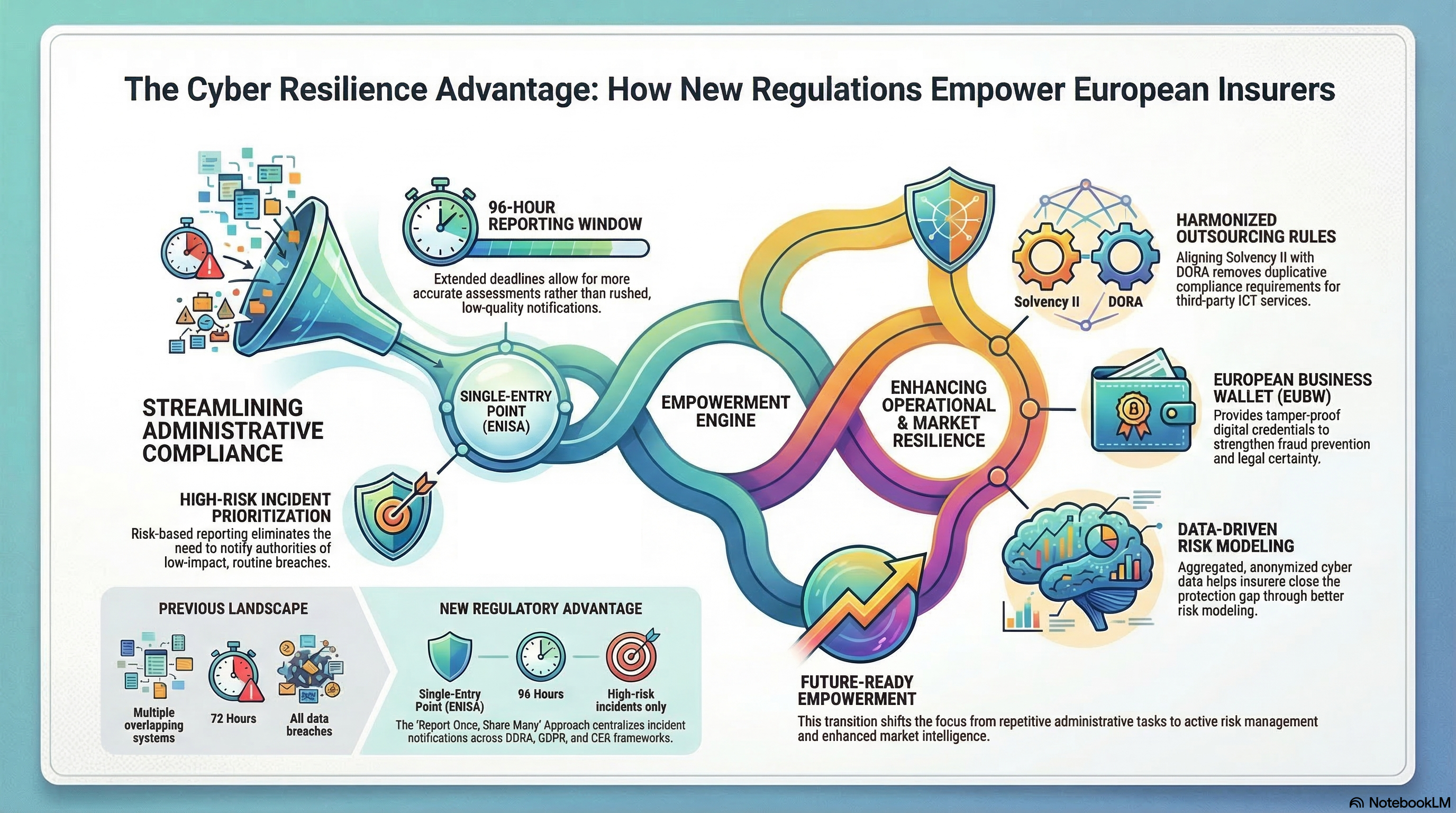
The most immediate catalyst for operational efficiency is the introduction of the Single-Entry Point (SEP) for incident reporting. Managed by ENISA, the SEP is designed to dismantle the silos that have traditionally forced insurers to report the same incident to multiple authorities under different formats.
Historically, a major cyber event required navigating a labyrinth of requirements for DORA, the Critical Entities Resilience Directive (CER), and GDPR. The SEP replaces this chaos with a centralized hub and unified reporting templates. By harmonizing these requirements, the SEP allows compliance teams to stop acting as administrative clearinghouses and start acting as active incident managers. This shift reduces duplicative work and ensures that the data reaching regulators is consistent across jurisdictions.
"The Single-Entry Point enables a 'report once, share many' approach, allowing organizations to submit a single notification that is shared across multiple frameworks."
Precision Over Panic: Why the 96-Hour Window Fortifies Defense
In the world of cyber defense, speed is often prioritized over accuracy, but rushed data leads to poor decision-making. The proposal to extend the data breach reporting deadline from the 72-hour GDPR standard to a 96-hour window is a pragmatic victory for the industry. This extension acknowledges a fundamental truth: more time results in more actionable intelligence for both the insurer and the regulator.
By allowing for a more thorough investigation before the clock runs out, insurers can provide high-quality data rather than speculative, rushed notifications. This is supported by a "risk-based" filter that eliminates the need to report low-impact breaches. When we filter out the noise of minor incidents, we allow compliance teams to focus their capital and talent on the threats that actually matter.
The strategic benefits of this calibrated approach include:
- Actionable Intelligence: Thorough assessments provide regulators with a clearer picture of systemic threats, creating a better feedback loop for the entire industry.
- Reduced Operational Friction: Staff can prioritize mitigation and recovery over the administrative rush of notifying authorities about non-consequential events.
Unifying the Digital Supply Chain: Legal Certainty and Secure Identity
Operational efficiency is also being driven by the "unification of the digital supply chain." By aligning the outsourcing rules of Solvency II with DORA's third-party risk management requirements, the EU is removing the duplicative compliance structures that previously plagued ICT service procurement. This harmonization provides "legal certainty," which is a significant competitive advantage in a digital economy where third-party dependencies are the primary source of risk.
A critical, yet often overlooked, tool in this harmonization is the European Business Wallet (EUBW). By providing tamper-proof company credentials and secure digital identification, the EUBW significantly reduces "onboarding friction" for B2B ICT partnerships. In an era of rampant deepfakes and sophisticated social engineering, having a verified, tamper-proof digital identity is a cornerstone for fraud prevention and secure digital ecosystems.
Furthermore, by simplifying the DORA register of information to focus only on "critical or important" ICT services, the quality of oversight is improved. We are moving away from a "quantity over quality" approach to data, ensuring that the administrative weight of tracking providers is proportional to the risk they pose.
From Shadows to Statistics: How Aggregated Data Closes the Protection Gap
Perhaps the most transformative takeaway for the market is ENISA's mandate to provide aggregated, anonymized cyber data to stakeholders. For years, the growth of the cyber insurance market has been stunted by a lack of high-quality, systemic data. You cannot price what you cannot model.
This influx of aggregated data allows insurers to move from shadows to statistics. With a clearer understanding of systemic risks across the continent, insurers can develop more accurate risk models. This leads directly to competitive pricing and more comprehensive coverage options for clients. By bridging the information gap, the industry can finally begin to close the "protection gap" that has left many organizations under-insured. It is a win-win: the insurer achieves better capital allocation through precise modeling, and the client receives more resilient coverage.
Conclusion: Resilience is the New Solvency
The evolution of European digital regulation proves that coherence is a catalyst, not a hindrance. As we look ahead, it is becoming clear that in the digital age, resilience is the new solvency. The insurers who thrive will be those who recognize that these frameworks provide the legal and operational bedrock necessary to navigate an increasingly volatile threat landscape.
By centralizing reporting, extending windows for the sake of accuracy, and leveraging aggregated data, the European ecosystem is positioning itself as the global leader in digital operational maturity. The "compliance tax" of the past is being transformed into the strategic resilience of the future.
Is your organization still viewing compliance as a hurdle, or are you finally leveraging it as your ultimate cyber-resilience advantage?