EIOPA seeks stakeholder input to further improve data collection for insurers and pension funds
The Future of Supervisory Reporting: Analyzing EIOPA's Integrated Data Collection Roadmap
1. The Solvency II Mandate and the RIDC Initiative
The European Insurance and Occupational Pensions Authority (EIOPA) has published its Discussion Paper (EIOPA-BoS-26-061) as a strategic precursor to the final report due to the European Commission. This initiative is strictly anchored in the mandate under Article 35(12) of the revised Solvency II Directive, which requires a comprehensive assessment of both legislative and technical measures to transition toward an integrated data collection system for the insurance and pension sectors.
The legal mandate defines three core objectives that must guide this transition:
- Reducing areas of duplication and inconsistency: Streamlining reporting frameworks across the insurance sector and other financial industries.
- Improving data standardization and sharing: Ensuring efficient use of data already reported within any Union framework by relevant national or Union-level competent authorities.
- Reducing compliance costs: Easing the administrative and operational burden on reporting entities.
The primary mission of the Report on Integrated Data Collection (RIDC) is to evaluate the feasibility of these measures. As a Senior Regulatory Analyst, I note that while the roadmap focuses on long-term efficiency, EIOPA is specifically tasked with prioritizing information related to collective investment undertakings (CIUs) and derivatives reporting, necessitating close cooperation with the European Banking Authority (EBA) and the European Central Bank (ECB).
2. Deconstructing the Reporting Chain: From Semantic to Infrastructure
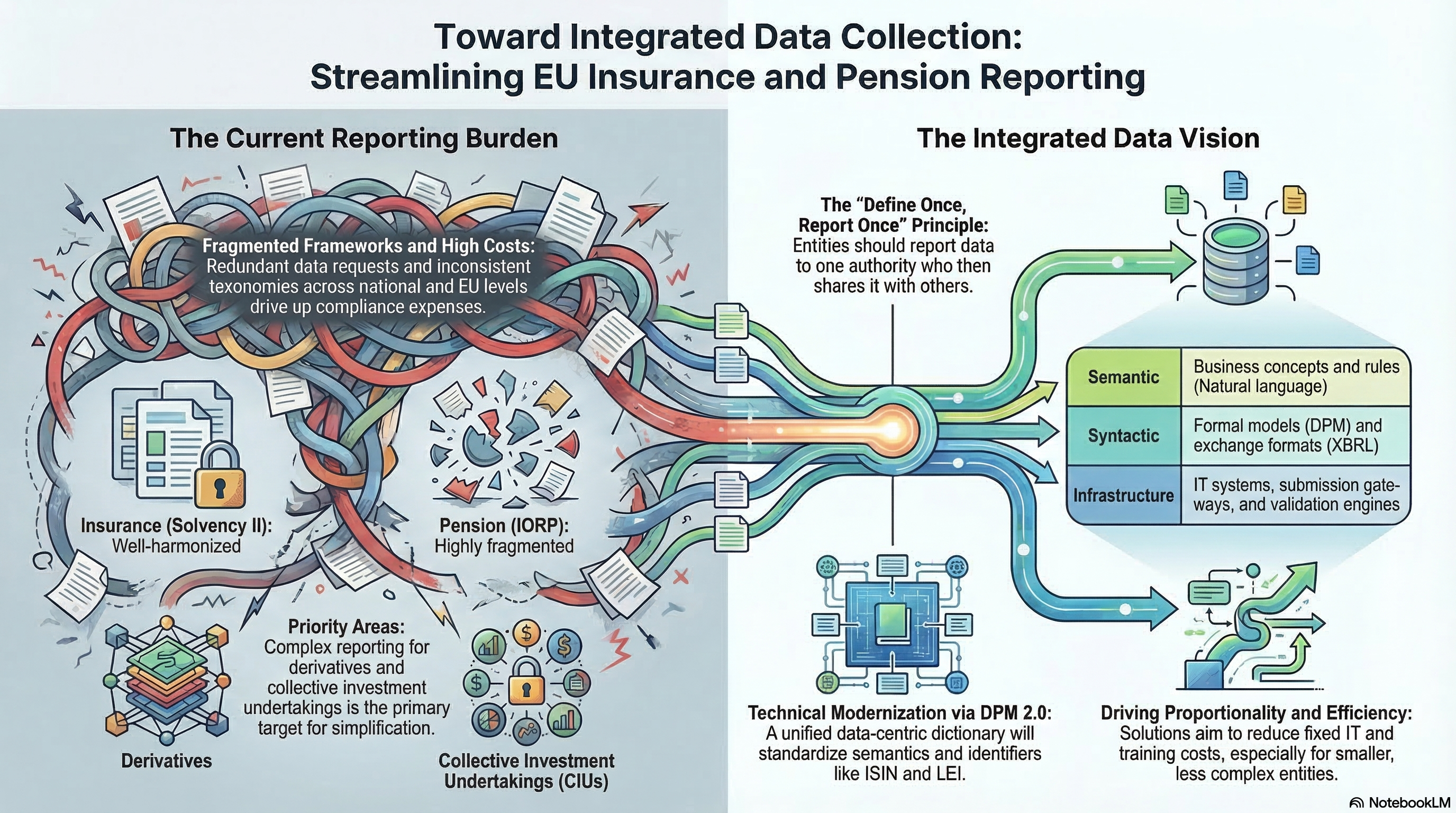
Effective regulatory integration requires addressing the reporting chain at various levels of abstraction. Using the framework established in the EBA feasibility study, EIOPA identifies three distinct layers where harmonization must occur to bridge the gap between business concepts and IT implementation.
Abstraction Level | Core Focus | Key Technical Components |
Semantic | Business concepts and rules | Definitions in natural language, harmonized glossary, and business logic. |
Syntactic | Formal representation and exchange | Data Point Model (DPM), exchange formats (xBRL), and dimensional schemas. |
Infrastructure | Systems and software supporting the data lifecycle | Data model software, submission gateways, and validation engines. |
The Data Point Model (DPM) serves as the "semantic bridge," breaking down regulatory requirements into individual data points with unique dimensional characteristics. To unify the glossary for insurance and Institutions for Occupational Retirement Provision (IORPs), the DPM Alliance (a partnership between EBA, EIOPA, and the ECB) is driving the evolution toward DPM 2.0. This standard is critical for preventing duplication and enabling a single, data-centric dictionary that unifies EU-level definitions across the insurance and pension sectors.
3. Sectoral Disparity: Solvency II Maturity vs. IORP Fragmentation
A significant challenge in creating an integrated system is the uneven maturity between sectors. The insurance sector currently operates under a "mature" level of harmonization thanks to Solvency II, utilizing common Quantitative Reporting Templates (QRTs) and a "define once, report once" strategy that successfully integrates ECB statistical add-ons into the Solvency II taxonomy.
Conversely, the IORP sector remains notably fragmented. Specific challenges facing IORP reporting include:
- Regulatory Power Gaps: Unlike the insurance sector, Article 50 of the IORP II Directive does not explicitly mandate regular quantitative reporting. This forces EIOPA to rely on Article 35(2) of the EIOPA Regulation, creating legal ambiguity that complicates data collection for some National Competent Authorities (NCAs).
- The "Two Lines" Burden: IORPs in many Member States must maintain separate reporting lines for national supervision and EU requirements. These lines often overlap in content but diverge in taxonomy and deadlines, doubling the compliance effort.
- Structural Heterogeneity: Extreme variations in pension scheme designs and national valuation approaches across Member States make the application of a single uniform format technically and conceptually difficult.
4. Technical Deep Dive: Derivatives and Collective Investment Undertakings (CIUs)
The Article 35(12) mandate places specific emphasis on derivatives and CIUs, as these represent the most complex areas of overlapping requirements.
Derivatives Reporting (Template S.08.01) EIOPA is exploring the potential to leverage EMIR (European Market Infrastructure Regulation) data to reduce the burden of quarterly position reporting. However, from a policy perspective, a "Report Once" reality remains distant due to several hurdles:
- Missing Insurance-Specific Fields: EMIR currently lacks data points essential for insurance supervision, most notably Solvency II valuation and unit-linked classification.
- Strategic Caution: EIOPA explicitly advises against any premature decisions to move away from Solvency II derivatives templates while ESMA is still simplifying financial transaction reporting (MIFIR/EMIR). Abandoning current templates before ESMA's work is finalized risks creating supervisory data gaps.
Collective Investment Undertakings (CIUs) The "look-through" approach (Templates S.06.02 and S.06.03) is vital for calculating capital requirements. While there is potential to leverage UCITS and AIFMD frameworks, the following limitations persist:
- Legal barriers preventing the cross-border use of national fund reporting for broader supervisory purposes.
- Incompatibilities in granularity and scope between asset manager reports and insurance-specific risk needs.
- Lack of non-aggregated information for fund-in-fund investments.
5. Evaluating Alternative Data Collection Architectures
EIOPA is analyzing three hypothetical scenarios for the future of data collection. It is vital for stakeholders to recognize that EIOPA maintains strict neutrality regarding these scenarios; they are presented for feedback and do not imply a finalized preference.
- Virtualized Interface: A standardized common API (Level Two) that simplifies submission for institutions while preserving NCA autonomy. It requires full harmonization of validation rules but limits the ability for NCAs to provide specialized national feedback.
- Intermediate Hub: A hybrid model where some NCAs join a central storage system while others maintain legacy mechanisms.
- Fully Centralized Hub: A Level One hub where all data is submitted directly to a joint system. While this maximizes harmonization and eliminates redundant data flows, it introduces significant risks:
- Critical Vulnerability: A single point of failure necessitating extreme security measures.
- Governance Complexity: Challenges in managing access rights and confidentiality across diverse jurisdictions.
- Loss of National Flexibility: National validation rules would effectively be eliminated.
6. The Economics of Compliance: Cost Drivers and Proportionality
Using the EBA framework, we categorize compliance costs into Initial Implementation (systems/training), Recurring Operational (ETL/submission), and Indirect/Opportunity costs.
Main Cost Drivers identified in the roadmap include:
- Inconsistent taxonomies and definitions between national and EU-wide frameworks.
- Overlapping templates (e.g., QRTs vs. ECB add-ons).
- Frequent taxonomy updates that destabilize IT implementation.
- Ad-hoc or "one-off" data requests outside periodic cycles.
Scale and Proportionality are critical concerns. Smaller entities face a disproportionate burden because fixed costs for external consultancy and IT development cannot be scaled down. Furthermore, group-wide reporting vs. local branch obligations introduces a layer of regulatory complexity that significantly inflates costs for larger, cross-border entities, leading to duplicative requirements that have yet to be fully streamlined.
7. Strategic Alignment with EU Initiatives
The RIDC roadmap is part of a broader European digital finance ecosystem. Alignment with the following initiatives is essential for long-term success:
- ESAP (European Single Access Point): Will facilitate public disclosure visibility for SFCR and SFDR data from 2028.
- BIRD/IReF: The ECB's initiatives for a harmonized reporting dictionary (BIRD) and a unified framework for statistical reporting (IReF).
- JBRC (Joint Banking Reporting Committee): Co-led by the European Commission, ECB, and EBA, this committee provides a governance blueprint for early cross-sectoral coordination and semantic integration.
- DPM Alliance: The formal MOU between EBA, EIOPA, and ECB ensuring joint governance over DPM 2.0.
8. Stakeholder Engagement and Next Steps
Stakeholder input is the only way to ensure the final report to the Commission reflects operational realities. EIOPA is seeking specific feedback on data format incompatibility, the facilitation of automation, and the utility of a comprehensive single data dictionary.
- Feedback Deadline: 10 June 2026, 23:59 CET (Critical hard stop for policy influence).
- Submission Method: Via the official EU Survey link.
The feedback gathered will directly inform the final report delivery to the European Commission, which will outline the legislative and technical path toward a truly integrated European supervisory data ecosystem.